
FAQs
Industrial Zoning FAQ
- Update zoning to align with the City’s Urban Industrial Land Reserve policies contained in the OCP.
- Increase flexibility and economic viability for industrial and employment-related uses and activities.
- Recognize and enable the needs of light, heavy and marine industrial operations.
- Ensure zoning helps to protect, maintain and intensify the City’s industrial land base.
- Encourage the inclusion of space for arts and cultural production, performance and education in light industrial areas.
- Allow complementary uses that support, but do not displace industry.
Why is the industrial zoning update happening?
To help implement the new Official Community Plan, Council directed staff to modernize the City’s zoning. Due to the complexity and volume of the Zoning Regulation Bylaw with over 900 zones, the modernization work is being completed in phases. This second phase builds on the Industry, Arts and Innovation District work that occurred in the first phase.
What are the objectives of the proposed industrial zoning modernization?
What is the focus of the new Marine Industrial Zone?
The Marine Industrial Zone (MI-1) preserves industrial zoning close to the working harbour and accommodates intensive industrial activities that benefit from deep-water harbour access.
The MI-1 zone introduces a new Marine Industrial use to accommodate shipyards, boat maintenance, repair and deconstruction activities as well as the assembly, production, or storage of marine-related materials and products.
What is the aim of the new Light Industrial Zone?
The Light Industrial zone promotes and supports the existing light industrial land base to preserve and enhance high-value ground floor light industrial space and support other light industrial, employment or arts and cultural uses on upper floors, including opportunities for other complementary uses that do not displace industry.
What is the aim of the new Heavy Industrial zone?
The Heavy Industrial zone aims to preserve and enhance the existing heavy industrial land base that is vital to support growth, development, innovation and economic prosperity within Victoria and the broader region.
What happened in phase one of Zoning Modernization?
In the first phase of the update, new zones were introduced for residential areas across the city, town Centres, urban villages and the industrial lands contained in the Industry, Arts and Innovation District.
What engagement occurred in the first phase?
The development of new industrial zones was largely informed through engagement that occurred as part of the Industry, Arts and Innovation District Action Plan and included feedback from over 500 people including a range of industrial property owners and businesses. Additional feedback was received in conjunction with the OCP engagement process, including a workshop with industrial stakeholders.
How will the City engage in the second phase of the zoning update?
Phase 2 included workshops and direct meetings with industrial property owners and businesses to inform the draft zones. A postcard is being mailed to industrial property owners, businesses, and industry partners to share information about the update and invite feedback.
What policy does this update align with?
This update aligns with the Council direction to modernize the City’s zoning bylaws, as well as the Urban Industrial Land Reserve and Working Harbour policies in Section 1.5 of the OCP.
Will the zoning update address community safety and wellbeing in Rock Bay?
No, the proposed update is focused on industrial zoning. Visit engage.victoria.ca/cswp to learn about the City’s Community Safety and Wellbeing Plan.
What is the OCP and when was it last updated?
On October 2, 2025, Council adopted a new Official Community Plan: Victoria 2050 after a two year planning process, including a public hearing.
The updated OCP charts a course for Victoria to address current and emerging challenges while honouring and enhancing the city’s unique and historic character. The plan sets the vision and framework to balance growth with preservation and guide the City’s work, decisions and actions over the next three decades.
The changes are part of a citywide process intended to support housing solutions, climate action and complete communities that will shape Victoria through to 2050.
To learn more about the OCP update process you can review the core materials Council considered and view past OCP Council sessions.
Employment Lands
- Approximately 100 properties in Old Town are Heritage Designated. Heritage designation provides the strongest legal protections, preventing demolition and inappropriate alteration.
- Old Town is also within a Heritage Conservation Area. This means that any property on the Heritage Register requires a heritage alteration permit for exterior alterations. Applications are evaluated against the same policies and guidelines as heritage designated sites.
- For properties with heritage merit but no heritage status, City policy encourages designation as part of adaptive reuse projects. The City also typically seeks designation of register properties when reviewing development applications.
Do the Old Town zoning updates increase the maximum building height or density in Old Town?
No. The proposed zoning amendments do not increase the maximum building height or maximum density in the Old Town zone.
All new development in the Old Town area continue to require a development permit or heritage alteration permit that aligns with key City policies and guidelines such as the Official Community Plan, Old Town Design Guidelines and The Standards and Guidelines for the Conservation of Historic Places in Canada.
If an applicant proposes a greater density or height in Old Town than what is currently permitted in the Zoning Bylaw, the process would be the same as it is today.
How will the tax exemption affect me and the taxes I pay?
The tax exemption program is designed to have little to no effect on all other taxable properties.
The tax exemption will exempt a new hotel development or expansion from the increase in municipal taxes that result from an increase in property value. This means the hotel property would continue to pay property taxes proportionate to the value of the property before the hotel development or expansion.
Taxable properties will continue to pay what they would have paid if no hotel was developed until the tax exemption expires. Once the exemption expires the hotel property starts contributing the full municipal tax amount.
Why are greater densities being proposed in the Central Business District?
The zoning changes would help to increase certainty for an applicant by having pre-defined zoning regulations, which reduces risk, and shortens the development timeline. It also helps improve the current window of opportunity for hotel development in the near-term and supports development of a variety of employment spaces in the CBD over the long term.
How will Old Town heritage be protected?
Victoria’s heritage program is among the strongest in British Columbia. Heritage in Old Town is protected in many ways:
How do these actions protect the future of Old Town and Victoria’s heritage?
The recently directed actions support Old Town’s economic health and heritage by permitting additional employment-focused uses (light industrial, veterinary clinic and laboratory) that can occupy existing spaces as well better support the adaptive reuse of heritage buildings.
The tax exemption for hotel uses further encourages the upkeep of heritage buildings for visitor accommodation, which can offer new customers for nearby businesses located in other heritage buildings.
How can the City do more to protect heritage?
These actions are part of a limited, near-term suite of solutions to support Victoria’s economy. The OCP also directs the renewal of the City’s heritage program. This long-term initiative has not yet begun.
Are greater densities proposed in the Central Business District?
Yes, the proposed zoning amendments to the Central Business District (CBD) would increase the maximum density for non-residential properties from 3.0:1 FSR to 5.5:1 FSR in the CBD-1 Zone[CM3] and from 4.0:1 FSR to 5.5:1 FSR in the CBD-2 Zone. The densities for development that includes residential uses will remain unchanged in the CBD zones
These amendments align with the density envisioned in the Downtown Core Area Plan.
What does 5.5:1 FSR look like? Will these be big buildings?
Floor Space Ratio (FSR) is a metric used in planning and development to describe how much total floor area can be built on a site relative to the size of the lot. It can also be considered density. Density can be expressed in the built environment in many ways – no two buildings with the same FSR look exactly alike.
There are a variety of buildings in the Central Business District that are around 5:1 FSR already, including:
The Atrium Building, approved at 5.0:1 FSR
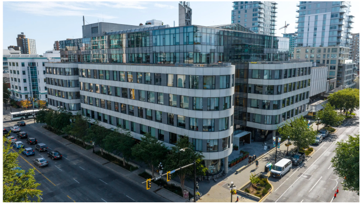 Photo source: jawlproperties.com
The Magnolia Hotel approved at 4.6:1 FSR.
Note it is in Old Town, rather than in the Central Business District.
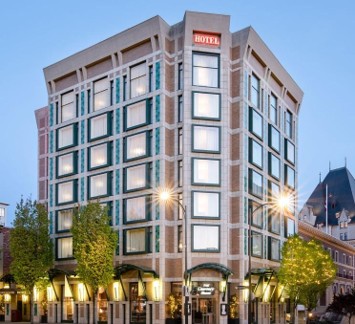
Photo source: destinationgreatervictoria.com
The Rotunda Building (six storeys) was approved at 3.7:1 FSR
750 Pandora (taller building) built as part of the same development was approved at 5.88:1 FSR.
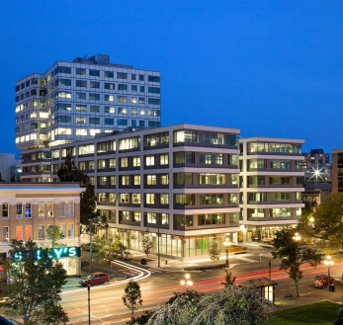 Photo source: jawlproperties.com
How else can the City support the downtown economy?
These actions are part of a limited set of near-term solutions to support Victoria’s economy. The OCP also directs other actions related to economic health, including renewing the plans for the downtown and the harbour, as well as ongoing economic planning. Stay tuned as this process is developed.
Why offer a tax exemption to hotels?
The Revitalization Tax Exemption is intended to spur new hotel development as a strategy to realize economic revitalization in a time of challenging economic conditions and to help address a scarcity of hotel rooms and increasing demand for visitor accommodation.
Economic conditions are currently making office and high-rise residential development unviable, and this creates an opportunity for hotel development downtown and throughout key nodes in Victoria. However, even hotel development viability is challenged by high construction costs. Analysis indicates that a Revitalization Tax Exemption can help overcome this viability challenge and spur new hotel construction, making it an especially timely and effective strategy for economic revitalization in Victoria.
The Greater Victoria Hotel Development Report estimated that significant direct and indirect economic revitalization effects will result from the creation of 2,000 new hotel rooms. This includes 2,760 direct and indirect jobs, $85 million in annual wages, $100 million in annual visitor spending and almost $50 million in annual tax revenue to various levels of government. Assuming the Official Community Plan goal of 1,500 new hotel rooms is achieved, approximately three quarters of this estimated economic revitalization effect stands to be realized within Victoria.